
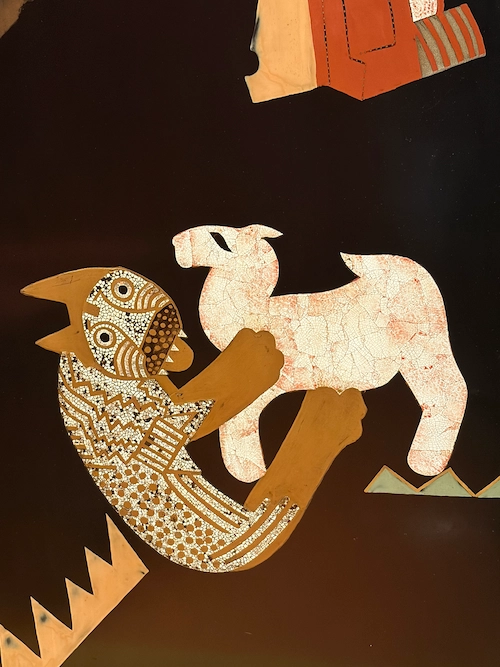
Exquisite Art Deco lacquer work combined with eggshell mosaic inlay on a 1923 Jean Dunan folding screen.
URUSHI – THE JAPANESE TRADITION
Urushi is sap from Rhus vernicifera, the Japanese lacquer tree. Trees must be over 10 years old and at least 10 cm thick for sap extraction. Raw urushi is purified, filtered and refined into different grades. Sessimé is purified flowing lacquer. Nashizi is transparent lacquer. These variations create different effects and colors.
The application process takes months. Multiple layers build a finished lacquered surface. First, the wooden surface is sealed with sessimé. Hemp fibers mixed with urushi and rice starch fill irregularities. Hemp cloth adhered with urushi paste reinforces the surface. Foundation layers of clay, water and urushi build the base. Each layer dries completely before sanding with charcoal, stone or ground clay.
Black lacquer results from a reaction between urushi and iron. A solution of iron filings in vinegar is added to sessimé. Layers of this black mixture are applied, finished with coatings of transparent sessimé. The drying process takes months in European climate. Traditional Japanese masters say lacquerware is made at the speed of a snail. This explains why authentic urushi pieces command exceptional prices.
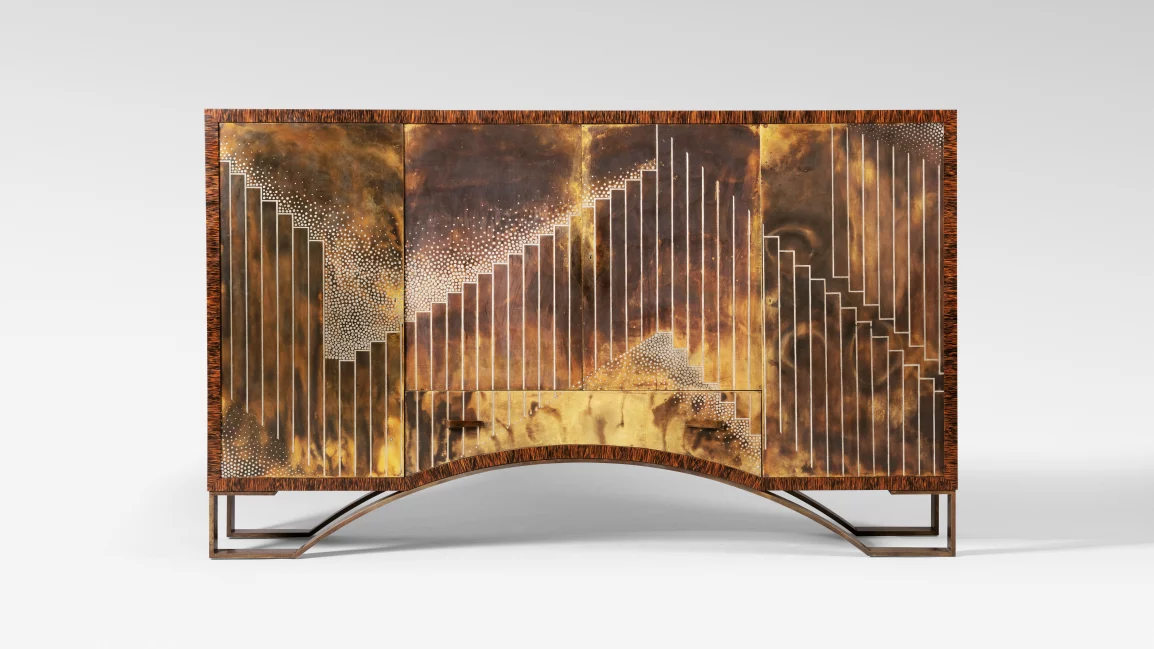
Sideboard by Jean Dunand and Eugène Printz. Photo © Sotheby’s
FROM TOKYO TO PARIS
Seizo Sugawara arrived in Paris in 1900 from Johoji, a village famous for lacquerware. He came as part of the Japanese delegation to the Exposition Universelle, overseeing lacquerware sent from Japan. Sugawara decided to settle in Paris. He became an important figure teaching Western artists Oriental lacquer techniques.
Jean Dunand took 13 lessons from Sugawara over two months in 1912. Dunand documented everything in his notebook. He recorded the Japanese names for techniques, tools and materials. He learned the 30-step process. He mastered the preparation, application and finishing methods. Less than a year later, he began producing his own lacquer pieces. Japanese artists typically take ten years to learn lacquer art. Dunand compressed this training into intense focused study.
Eileen Gray, the Irish architect and furniture designer, also studied with Sugawara. She became a long-time collaborator. Both Dunand and Gray transformed Japanese technique into European Art Deco language. They applied urushi to modern forms with contemporary imagery. This fusion created a new vocabulary for luxury decorative arts.
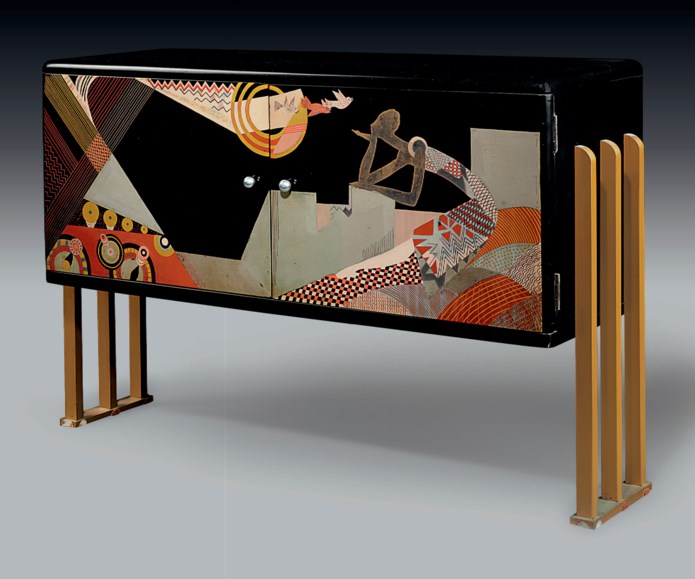
Radio Cabinet by Jean Dunand, circa 1929. Photo © Christie’s
JEAN DUNAND AND THE ART DECO GOLDEN AGE
Dunand applied lacquer as if painting a composition. He combined Asian and African motifs with Cubist abstractions. His fantastical hybrid imagery shaped Art Deco visual vocabulary. He honed avant-garde signature techniques. He affixed broken eggshell fragments to lacquer since white could not be achieved with urushi. He sprinkled gold and silver powder following Japanese maki-e traditions. He inlaid mother of pearl for additional decorative effects.
The 1925 International Exhibition of Modern Decorative and Industrial Arts in Paris cemented Dunand’s fame. He designed a fully lacquered smoking room for the French Embassy. When the Japanese delegation visited and saw lacquer everywhere, they were stunned. Europeans had taken their ancestral technique and made it their own. This ironic culture shock inspired a lacquer renaissance within Japan.
Dunand received commissions for ocean liners. His first in 1927. His most famous being the SS Normandie during the 1930s. This luxurious ship employed the finest Art Deco makers. Dunand designed a magnificent smoking room featuring La Conquête du cheval. The fully lacquered panels created immersive environments. These large-scale architectural applications proved urushi could transform entire rooms into jewel-like spaces.
Explore our curated Jean Dunand Furniture Pinterest board for more examples of his lacquer masterpieces
DECORATIVE TECHNIQUES
Lacquer works beautifully with other decorative materials. Maki-e involves sprinkling gold or silver powder onto wet urushi, creating detailed patterns and imagery. Gold leaf can be applied for larger areas of gilding. Mother of pearl inlays add luminous accents. Eggshell fragments create textured white surfaces impossible to achieve with urushi alone. These combined techniques produce the richest decorative effects, transforming functional furniture into art objects.
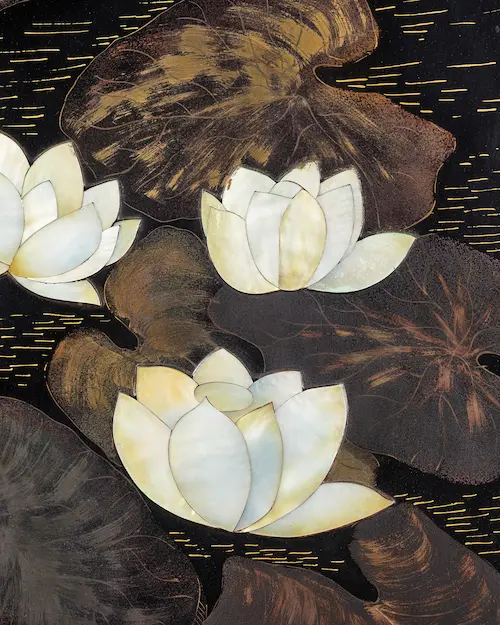
Jean Dunand, detail of lacquered bed with water lilies and fish, 1932. Photo © Christie’s
LACQUER FURNITURE
French artisans apply urushi to furniture following Art Deco traditions established by Jean Dunand. Vases, boxes and decorative objects showcase the material’s depth and luster. Tables, cabinets and consoles transform functional pieces into sculptural statements. Folding screens become room dividers with landscape scenes or abstract compositions. Each application requires complete mastery of the 30-step process.
The depth of lacquer distinguishes it from all imitation products. Light penetrates the thickness of superimposed layers, playing by transparency. The eye never stops on the polished surface. This depth creates a luminous quality unmatched by modern synthetic lacquers. Authentic urushi pieces develop richer patina over time. Properly maintained, they last centuries.
Studio Ziricote works with French artisans who maintain these traditional techniques. They source from specialists who understand both classical reproduction and contemporary design. Some focus on small decorative objects. Others create large furniture pieces. All share commitment to authentic urushi application following Japanese methodology adapted by Dunand.
LACQUER WALL PANELS
Jean Dunand proved urushi works magnificently at architectural scale. His smoking room panels for the French Embassy in 1925 demonstrated this potential. His SS Normandie commission required entire walls covered in lacquer. These installations demanded not only technical mastery but also compositional vision across multiple panels.
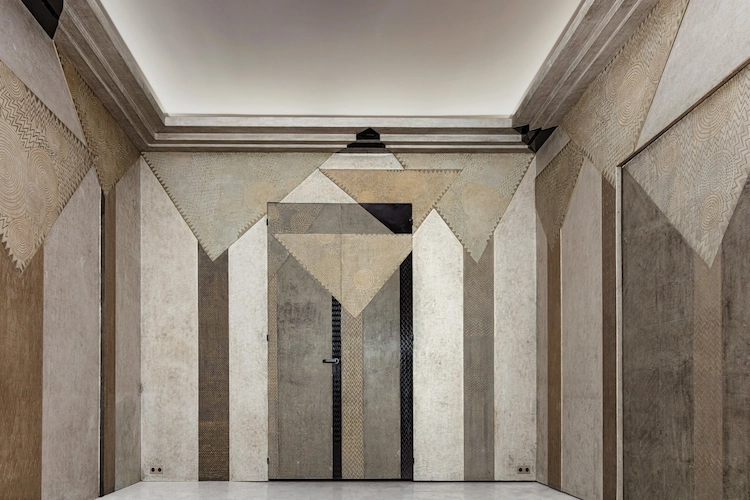
French artisans today create lacquered wall panels for luxury residential projects. Panels for studies, libraries, dining rooms and master suites. Some feature landscape scenes. Others showcase geometric patterns or abstract compositions. The panels can incorporate maki-e gold work, mother of pearl inlays or eggshell accents. Each installation creates a unique atmosphere through the interplay of lacquer depth and light.
Architectural lacquer requires careful planning. Panels must be created to precise dimensions. The composition must flow across multiple sections. Installation demands specialized knowledge to preserve the delicate surfaces. Transport and handling require white-glove care. Studio Ziricote coordinates these complex projects from initial design through final installation.
Lacquered wood, lacquered metal, gilded wood. Les Palmiers’ smoking room, from the residence of Mademoiselle Colette Aboucaya, Paris. Photo © Phillips
WORKING WITH STUDIO ZIRICOTE ON LACQUER PROJECTS
Your lacquer project begins with understanding your vision. A single decorative object or complete furniture collection? Architectural wall panels for one room or multiple spaces? Traditional Art Deco aesthetic or contemporary design? Each application requires specialized expertise. We identify French artisans who master authentic urushi techniques following Jean Dunand traditions.
Lacquer projects require patience. The material demands time for proper application and natural drying cycles. This cannot be rushed. Authentic urushi application follows traditional methods established over centuries. Modern synthetic lacquers dry faster but lack the depth, luminosity and longevity of traditional urushi.
We manage the complete project from artisan selection through delivery and installation. We coordinate design development, review samples and progress, inspect quality on your behalf. We arrange specialized transport and white-glove installation. Your lacquer pieces arrive ready to transform your interior.
READY TO START YOUR LACQUER PROJECT?
Custom furniture, wall panels, millwork. We identify the right maker and manage the complete process from France to your residence.
Explore our curated Lacquer Furniture and Wall Panels Pinterest board for more examples of his lacquer masterpieces